


Frankfurt am Main, December 10, 2025. – Featuring around 1,600 international exhibitors from 45 countries, EMO Hannover 2025 provided a global showcase for innovation in production technology from September 22 to 26. 50 years after the premiere of the world’s leading trade fair for production technology in Paris, the focus was on forward-looking aspects, such as artificial intelligence and digitalization, automation and sustainability. The exhibitors impressively demonstrated how modern production technologies are now more networked, intelligent and resource-saving than ever before. The technologies include everything from smart machines and IoT-based applications through to AI-supported production processes and systems for data-driven analysis. EMO Hannover 2025 offered an 360° overview of the current state of industrial manufacturing and its future.
The developments – especially in the field of automation – were on show in numerous areas at the trade fair. Visitors were given an insight into the current state-of-the-art. The latest systems showed how it is increasingly possible to operate production lines without human intervention. The solutions presented help to minimize error rates, improve product quality and increase production speed. Flexibility is also being optimized in production, which is opening up new customization and scaling opportunities for companies.
Another key topic at the event was sustainability in industrial production. The concepts and technologies on display were not only aimed at improving the ecological credentials of companies, but also demonstrated concrete ways of raising the efficiency levels of machines. There was a particular spotlight on developments aimed at reducing energy consumption.
A further focus was on the use of artificial intelligence in industrial production. Various AI applications were presented at EMO Hannover 2025 which have the potential to change production processes on a permanent basis. These included intelligent chatbots that can be used as digital assistants in machine operation, maintenance and production planning. Such systems enable intuitive human-machine interaction, assist operating personnel and reduce the amount of training required. In addition, various advanced AI models for process optimization were presented. These analyze large volumes of production environment data, identify patterns and deviations, and adapt processes autonomously.
Selected highlights from various topic areas are presented below. They illustrate not only the innovative potential of the exhibitor companies, but also the diversity of the technologies themselves.
Moving towards autonomous production – Automated machine tools and components
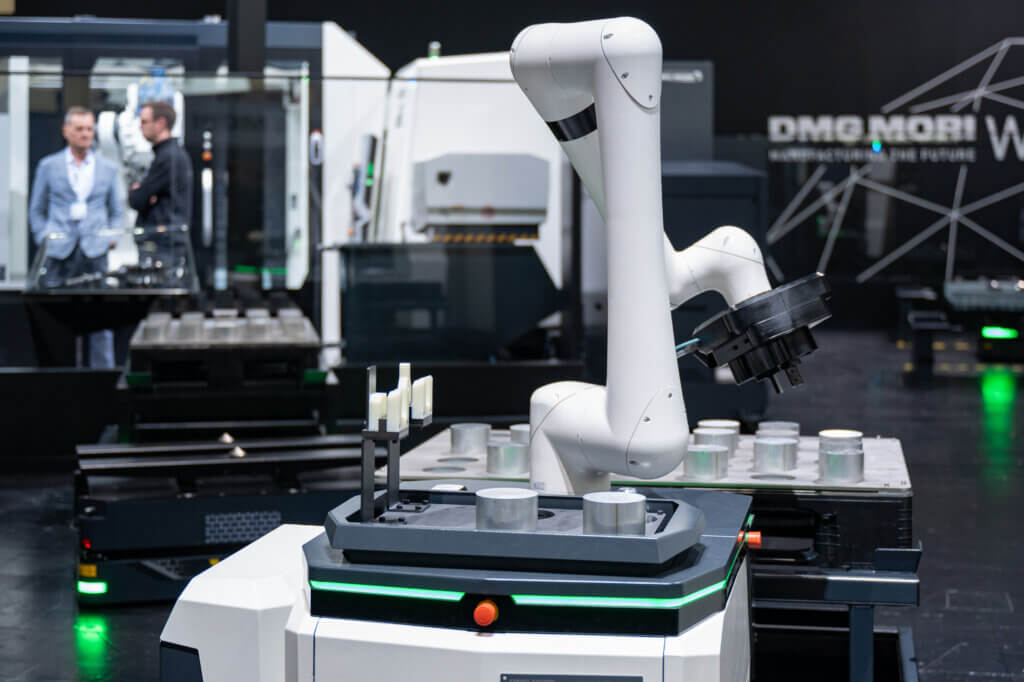
DMG Mori (Bielefeld, Germany) placed the technical focus firmly on automation and process integration at EMO 2025. 33 of the more than 40 machines on display were automated. A particular highlight here was the new AMR 1000. This is a driverless transport system for workpieces and tools that significantly increases machine capacity through continuous autonomous operation.
Combining milling, turning and grinding in a single setup, the DMC 125 FDS Duo Block stood out as a prime example of process integration. Among the world premieres at the event was the 2nd generation DMC 65 Mono Block, optimized for simultaneous high-precision 5-axis machining. A further innovation was the Ultrasonic 60 Precision, which combines 5-axis milling with ultrasonic technology and 4 µm positioning accuracy. The processes were digitally networked using the Celos X control system. With its consistent further development in the direction of automated and digitalized production, DMG Mori is following the general industry trend of offering machine tools, peripherals and software from a single source, with the aim of achieving optimum interaction between all components.
United Machining Solutions (Bern, Switzerland), recently formed by the merger of the United Grinding Group and GF Machining Solutions, presented several world firsts at the new group’s first joint trade fair. The latest technologies in various areas from grinding, milling and eroding through to laser processing and automation were unveiled at a special event held on the very first day of the fair.
A particular highlight was the Studer S23 universal cylindrical grinding machine. Its superior precision, flexibility and modern software integration are especially impressive. The Studer S23 is equipped with “C.O.R.E.” (Customer-Oriented REvolution) technology, which allows intuitive machine operation via a large and user-friendly touch screen, and with an automatic B-axis with 1° Hirth serration and a machine bed for optimized vibration characteristics. The machine is extremely versatile, with up to three grinding wheels that can be used simultaneously. In the area of wire-cutting EDM machines, the new Agie Charmilles CUT S series, consisting of the CUT S 400, S 600 and S 800 models, was presented. These machines combine outstanding machining accuracy with high productivity and have been specially designed for integration into automated production cells. United Machining Solutions also presented a high-precision 5-axis milling machine for micromachining in the form of its Mikron Mill P 500 U VHP (Very High Precision). In addition to thermal stability, it features highly dynamic drive and spindle technology for superior surface qualities and sophisticated component designs. The machine has a thermally insulated housing that protects against external temperature fluctuations and ensures optimized thermal stability and consistent precision levels during operation. In the field of automation, United Machining Solutions presented its 3R Transformer T3-600 system, a specially developed solution for workpieces weighing up to 600 kg. The flexible handling system can be integrated into different machine environments. It raises efficiency levels through its reduced manpower requirement and by offering continuous running.
EMO is 50 this year – and Grob (Mindelheim, Germany) is about to celebrate its centenary, which the company marked by showcasing pioneering solutions in the fields of machining and automation. Prominent among these were the new G400 4-axis universal machining center for pre-machining and simple machining, the G550T 5-axis universal mill-turn center and the powerful G920F5 machining center for mega and giga aluminum castings. In automation, it presented the PSS-R900 rotary pallet storage system which has space for 27 pallets and can be loaded by Automated Guided Vehicles (AGVs). Grob thus demonstrated the importance of the current automation trend.
Grob’s GMP300 is also setting standards in the additive manufacturing of aluminum products in the form of liquid metal printing. In future, the intention is for the system to additively manufacture other materials. The Grob portfolio is complemented by smart digitalization solutions such as Grob Manufacturing Execution (MES) and Manufacturing Operations Management (MOM) systems as well as large-scale battery cell production systems.
One of the products being premiered by machine tool manufacturer Okuma (Oguchi, Japan) was the MS-320H horizontal machining center, which facilitates autonomous productivity in particularly small spaces thanks to its vertical table arrangement and continuous chip conveyor. The Multus U3000 5-axis turning/milling center (120 tools, second turret) was used to give a live demonstration of friction stir welding. The process’s main advantage over conventional welding is its ability to create a firmly bonded welded joint in a normal machine tool without the need for dedicated welding technology. This widens the range of what is possible in a single clamping operation beyond simple machining. Okuma’s new machines meet sustainability requirements by reducing energy consumption through optimized idle management.
Alongside machine tools, Mazak (Oguchi, Japan) presented a number of significant technical solutions for process integration and automation. The highlight here was the European premiere of the Integrex j-200 Neo multi-tasking machine. One of the manufacturer’s main innovations in the area of automation is the coupling of production machines with industrial robots which can be controlled directly via the CNC machine tool, eliminating the need for the operator to have dedicated robot programming knowledge. Turning to software, Mazak presented its Mazatrol DX digital service, which uses AI and 3D visualization for cycle time optimization and helps in the creation of both quotations and NC programs. The company also showcased pallet pool systems and robot cells for unmanned operation. Mazak, too, is following the trend of offering complete integrated production chains. For example, all process steps – from the laser cutting of solid material through to automated handling and final machining – are offered from a single source in order to achieve complete digital traceability of the workpieces.
The machine tool manufacturer Röders (Soltau, Germany) presented further developments in its RPT Series of 5-axis high-speed milling centers. The main focus here was on increasing precision levels. The improvements achieve positional accuracy of under 1 µm and the centers can create surface finishes in steel in the single-digit nanometer range. A prominent technical highlight here was the RPT800DSH in a two-spindle configuration. The combination of a ball-bearing main spindle (36,000 rpm, HSK E50) for roughing and pre-machining, and a high-precision, air-bearing spindle (80,000 rpm, HSK E25) for finishing enables complete machining in a single set-up for maximum surface quality. In order to achieve maximum accuracy even with fluctuating ambient temperatures, Röders has developed a temperature control system that includes active thermal stabilization of all relevant machine components, including the torque motors in the rotary axes and the linear guides. According to Röders, this ensures zero-point stability of ±1 µm even with ambient temperature fluctuations of ±3 degrees Celsius. This reduces the need for extensive analysis of ambient influences, which previously had to be carried out predominantly by experienced personnel.
At EMO Hannover 2025, Schaeffler (Herzogenaurach, Germany) placed its technical focus on automation solutions in machine tool peripherals and on precision components for greater efficiency. One such technical innovation was the four-row KLLT linear guideways in an X arrangement. They are specially designed for handling systems and, in contrast to O-arrangements, can adapt better to substructures with small form errors without generating constraining forces. Schaeffler presented its new series of YRTA rotary axis bearings. These double-direction thrust roller rotary axis bearings offer high tilting rigidity for automation tasks thanks to adapted manufacturing processes and a new needle roller cage. The new products were supplemented by precision angular contact ball bearings for screw drive bearings. These use low-wear ceramic balls for the first time, effectively doubling the grease operating life and considerably reducing the amount of resources used in operation.
In the field of process monitoring, the BFD ultrasonic position sensor from Balluff (Neuhausen auf den Fildern, Germany) can be used to monitor clamping processes. It helps to avoid machine downtimes, increases process reliability and enables precise condition monitoring even under difficult ambient conditions. The BFD sensor uses an internal reference system to determine the clamping position instead of measuring the hydraulic pressure. The company’s portfolio is complemented by high-performance network solutions in the product lines that are designed to be cost-efficient, robust, hygienic or safety-oriented, depending on requirements. This modularity allows them to be integrated easily into existing and new systems. Balluff also presented advanced condition monitoring systems that can be used to analyze machine conditions in real time. This allows maintenance to be planned in advance, downtimes to be reduced and system availability to be greatly increased.
Beckhoff (Verl, Germany) presented its MX system – a compact, modular automation solution system that combines all the functions of a conventional control cabinet in a directly pluggable, IP67-protected housing. The control system, drive technology and power distribution are mounted directly on the machine, with no control cabinet. This saves a significant amount of space, cabling and material costs, but also reduces the installation time from 24 hours to one hour for a reference control cabinet – and there is no need for a qualified electrician to be present. The passive cooling system also means there is no requirement for energy to cool the system. In addition, a dedicated app that connects to the individual modules simplifies service and maintenance.
In the field of automation development solutions, a variety of robot systems capable of carrying out a wide range of tasks were exhibited at the EMO. The focus on the stand of Fanuc (Oshino, Japan) was on the new 500i-A CNC series controller, which features an impressive increase in computing power, improved 5-axis simultaneous machining, and the ability to achieve optimized surface quality. The system also offers simplified integration into digital systems such as the ROS2 Robot Operating System based on the IEC 62443 cyber security standards and the EU Cyber Resilience Act. The αi-D Series SERVO enables higher speeds and precision with 10 to 15 percent lower power loss. The system also requires up to 30 percent less space.
Kuka (Augsburg, Germany), another exhibitor in the field of robotics, presented its new KR Titan ultra heavy-duty robot, which can move up to 1.5 metric tons and is designed for applications such as pallet handling and battery assembly. The portfolio is complemented by the KMP 1500P mobile platform, an autonomous transport system that facilitates material flows for heavy components. The iiQKA.OS2 operating system was introduced for virtual commissioning. In addition, the iiQKA.mx Automation software interface has been expanded in cooperation with Siemens to include the Standard Robot Command Interface (SRCI) industry standard. This ensures greater flexibility in the integration of robotic products. Heidenhain (Traunreut, Germany), a specialist in control technology, uses another standardized interface to control and program the robots. An interface has been added to the control system that allows the robot and machine tool to be operated in tandem.
In the field of automated tool management, Wassermann Technologie (Eichenzell, Germany) presented the new Tool-L storage system, which can store up to 5,000 cutting tools with HSK-A63 holders in a minimum of space (basic version approx. 12 m²) with movable walls thanks to its modular design. It is suitable both as a central storage core and as an additional magazine for use directly on the machine tools. It can readily be integrated into automated production environments, even with AGVs, thanks to its robot arm, traversing axis and suitable grippers.
At EMO Hannover 2025, the Australian company Anca (Melbourne, Australia) showcased a number of innovations that combine sensor technology, digitalization and autonomous production. A key element here was the Ultra technology, which helps provide greater accuracy, repeatability and productivity during grinding based on high-precision axis control, intelligent servo algorithms, high-performance mechanical components with nano-resolution in the linear axes, and AI. Particularly noteworthy are the new MicroX Ultra machine models, designed for micro tools with tool diameters of D > 0.03 mm, including in-process laser measurement and spindle temperature compensation. The MX7 Ultra for the automated grinding of indexable inserts with complex contours benefits from the same technologies. Anca is setting software and automation standards with its AIMS Connect platform. It combines job management, digital work instructions and operator guidance – even in existing machines from different manufacturers. It thus creates transparency and traceability and results in fewer manual interventions. All in all, Anca demonstrated how modern sensor technology, smart control and autonomous processes come together to form an integrated ecosystem – a decisive step towards Industry 5.0, which offers not only more efficiency but also greater flexibility. With regard to sustainability, the increased use of linear motors and the frequency control of lubricoolant pumps combined with proprietary software to reduce cycle times and optimize feed rates ensures lower energy consumption during machining processes. Anca’s EPX-SF stream finishing machine facilitates precise cutting edge preparation and corresponding surface finishing of cutting tools. Technically, the EPX-SF features an impressive and innovative 11-axis architecture, which is distributed across three independently operating spindles. These enable uniform, fully-controlled machining of the tool shape, including the cutting edges and overall surface structure. The machine makes use of AI-based analysis functions to detect deviations at an early stage and automatically compensate for them. The EPX-SF underlines Anca’s leading role in the development of intelligent and automated manufacturing solutions. It combines superior surface quality with industrial efficiency and thus creates a decisive building block for future-proof, autonomous tool production environments.
A further technological highlight came from Index (Esslingen, Germany), which is setting new standards in turning with its High Dynamic Turning 2.0. The system is easy to integrate and can be implemented on existing Index lathes. Following the conventional application in conjunction with milling spindles, as presented by Ceratizit in the form of FreeTurn in 2019, the process is now being expanded to include the use of gear tool holders. This enables simultaneous use of the system on turning/milling centers. At the heart of the process is the variable setting angle of the turning tool, which is dynamically adjusted by the machine control system during machining. This means that complex contours can be machined continuously and flexibly without changing tools. Furthermore, chip formation can be adjusted to increase process reliability. Index is also developing a tool holder for several tools based on the FreeTurn system. This combines multiple cutting functions in a single tool holder by rotating the milling spindle accordingly. For multi-spindle machines in particular, this yields reductions in the number of tools and slide occupancy.
Clamping technology in sustainable production
The exhibitors in the clamping technology sector demonstrated the present-day challenges that can arise when clamping workpieces and tools. They presented various radically new solutions, but also intelligent further developments of existing solutions for various clamping situations.
The innovations presented by the Roemheld Group (Laubach, Germany) focused on the digitalization and automation of clamping systems for Industry 4.0. The Stark Spheric zero-point clamping system was a world first. It combines zero point clamping with pendulum compensation and length correction to enable stress-free clamping of free-form surfaces with a stable zero point. Another important technical innovation was the introduction of media feed-through for electrical signals in zero-point clamping systems. For the first time, this permits digital communication from the machine table via the pallet to the vise, and includes sensors for monitoring the clamping status. In the field of electromechanics, a particularly compact swing clamp for confined installation spaces was presented. Driven by a 24V DC motor, it allows precise position and clamping force control.
Schunk (Lauffen/Neckar, Germany) presented an internal clamping system for workpieces that uses hydraulic expansion technology to hold rotationally symmetrical components with an internal diameter of 450 mm. Also being showcased was the new Rota THW3 2+2 power chuck, which enables flexible and precise clamping of a wide range of workpiece shapes thanks to its compensating function. The sealed design, permanent lubrication and quick jaw change system mean that it can offer high process reliability with minimal maintenance. Schunk has also added the Kontec KSC-5X to its portfolio in the field of 5-axis clamping technology. The compact clamp is designed for complex workpieces and offers an impressively high level of flexibility, including a quick-change system and an integrated zero-point interface for modular applications. Another pioneering highlight was the electrically controlled zero-point clamping module NSE3-PH 138 IOL with integrated sensors. It allows seamless, real-time monitoring of various clamping states without the need for additional sensors on the workpiece. The innovations were supplemented by clamping devices that can be controlled wirelessly via IO-Link, and zero-point clamping systems with an integrated battery for electrical clamping. These represent significant steps towards smart and autonomous production.
The tool chuck manufacturer Rego-fix (Tenniken, Switzerland) presented new developments in the area of process reliability and monitoring. The company’s main product is the powRgrip system. This was developed by Rego-fix itself and is based on the principle of pressing collets into chucks. A further technical highlight was the AI-supported PGU 9900neo clamping unit. This unit automates the clamping cycle in just 8 to 10 seconds and integrates real-time monitoring. Sensors measure the clamping force. All process data is sent to a cloud for traceability. The press-fit principle has now also been mechanically extended for tool diameters from 20 mm to 40 mm, making the high vibration damping and precision available for larger tools.
Measuring and testing technology is indispensable in automated operation
Just how indispensable measuring and testing technology is in quality assurance was highlighted at EMO Hannover 2025. It represents an important component for ensuring stable and efficient production processes in automated manufacturing processes.
Renishaw (Wotton-under-Edge, United Kingdom) presented its new Equator-X 500 dual-method gauge together with the intuitive Modus IM Equator software. The Equator-X 500 has been specially developed for the production environment and combines absolute and comparative gauging in a single device. Delivering high speeds of up to 250 mm/s in absolute mode and 500 mm/s in compare mode, it enables fast and precise quality control within the production process itself. The dynamically stiff hexapod structure with linear motor drives and separate frame for displacement measurement ensures reliable and accurate measurement results, even in demanding circumstances. The measurement uncertainty of the system is 2.1 µm over 300 mm at 18 to 22 degrees Celsius. The Modus IM Equator software offers a user-friendly interface that considerably simplifies programming and operating the gauging system. In this way, Renishaw supports the continuous validation and optimization of production processes by feeding the measured variables back into the processing step. In addition, the software can independently generate an inspection program by loading CAD models.
The measuring device manufacturer Zoller (Pleidelsheim, Germany) showcased the integration of artificial intelligence into tool measurement. The primary technical innovation was the zKI (Zoller Artificial Intelligence) software solution. This system can be integrated directly into setting and measuring devices. It uses AI-based image processing to detect, analyze and evaluate wear patterns on tool cutting edges. The AI issues recommendations for action based on this. Zoller also presented the micBox. This is an automated solution for rotating and exchanging indexable inserts. Supplemented by an AI-supported camera module, the system can react autonomously to the condition of the individual cutting edge, enabling it to operate without human supervision.
Johs. Boss (Albstadt, Germany) presented fully automated thread inspection options using the MultiCheck 4.0 and MultiCheck 4.0-SPIN testing systems. These combine three inspection functions in a single measuring system: gauging, thread depth and thread conformity measurement. Thread depths of up to 50 mm can be measured. Thanks to its compact design and high test reliability, the system is suitable for use on the machines themselves, on processing machines as well as for centralized use in quality assurance.
Focus on networking, digitalization and artificial intelligence
Alongside the clear trend towards automation, many exhibitors demonstrated how intelligent systems can make modern manufacturing more efficient, flexible and sustainable. The boundaries between digital and physical production are becoming increasingly blurred, opening up new opportunities for greater competitiveness and innovation.
The AI + Digitalization Area in Hall 6 was a central meeting point for trade visitors keen to find out about the practical uses of artificial intelligence and digitalization in manufacturing. In the joint exhibition area, companies and research institutions presented specific applications that can be used to make production processes more intelligent, efficient and transparent.
The special AI Hub stand at EMO Hannover 2025 sent a clear signal about the increasing importance of artificial intelligence in industrial value creation. All the solutions presented were geared towards specific use cases and practical production-related issues. A central element of the hub was the AI-supported chatbot Emil which was commissioned by the VDW and developed by aiXbrain (Aachen, Germany) in close cooperation with WZL (RWTH Aachen University, Germany). In technical terms, Emil is based on a Large Language Model (LLM) which was specifically trained with the digital data from the EMO Hannover exhibitor directory. Visitors were able to interact directly with the chatbot in German or English via a terminal to find AI solutions in the field of metalworking and then view a list of suitable exhibitors, including their locations.
The current state of standardized machine communication via OPC UA was demonstrated by the global umati (universal machine technology interface) initiative based on real application examples. It showed how machines and software can be networked to securely record production data and integrate it into digital processes. This applies, for example, to energy consumption analyses which are made possible by the standardized communication of energy consumption. Another technical innovation that was presented was umati Connect, an open source software solution that enables direct communication between umati and the US standard MTConnect for the first time, thus demonstrating the compatibility of both standards in practice. The innovations were complemented by demonstrations of digital product tracking which link umati OPC UA Job Management directly with the Asset Administration Shell (AAS).
Heller (Nürtingen, Germany) presented various high-performance machine tools, but also showcased a range of digital and AI-supported services that optimize operations. The main focus was on the intelligent chatbot ASK.me. It provides context-sensitive answers to queries relating to maintenance, fault diagnosis and status. Production and status data is recorded and evaluated with the help of artificial intelligence and then presented in a comprehensible way in the form of texts, diagrams and tables. This enables targeted process optimization and predictive maintenance, and also reduces unplanned downtimes.
A particular highlight on the Siemens stand (Munich, Germany) was the Machine Tool Robot (MTR) which was developed in collaboration with Fraunhofer IFAM and autonox Robotics (Willstädt, Germany). The MTR combines a new type of drive technology with model-based control strategies and an optimized mechanical structure, enabling it to achieve outstanding path accuracy even at high feed rates and during complex movements. The MTR thus attempts to close the gap between conventional industrial robots and machine tools.
Siemens also presented the first developments of an AI-supported chatbot that is to be integrated into control systems. It will enable intuitive and supported operation of the CNC control system. Users can communicate directly with the control system in order to create programs, adjust process variables based on stored tool data, or carry out fault diagnostics for the control system and machine tool. The chatbot can also assist with machine maintenance. This will considerably simplify operation and increase efficiency in production.
Tool development and tool production are also benefitting from technological progress and artificial intelligence. Cutting tools used for machining metals have to meet very high requirements in terms of surface quality, process reliability and tool life. Meeting these requires precise micro-cutting with a high degree of repeat accuracy. Profin Progressive Finish (Zurich, Switzerland) uses flakkoting which allows it to produce individual micro-blades quickly and efficiently at all tool cutting edge positions. Edge preparation is used both in tool grinding machines and as a separate process in Profin’s controlled six-axis machines. The new Micro AI calculation program allows the edge preparation processes in grinding machines as well as in external applications to be calculated using AI. The best and most appropriate brush tools for specific processes can also be supplied from a wide range. The new software calculates all the process parameters required for edge preparation. These can be calculated for applications in grinding machines or for separate (out-of-grinding) processes. They include not only applications for simple drilling tools, but also the preparation of complex tool shapes such as radii, steps, chamfers, flutes and threads.
Additive manufacturing helps with workpiece clamping and special components
Additive manufacturing is increasingly supplementing conventional production processes, particularly for complex workpiece clamping and the manufacture of customized special components. At EMO Hannover 2025, numerous exhibitors showed how 3D printing processes are bestowing new design freedoms, thus increasing flexibility in production and aiding process optimization. The technology demonstrates its full potential in the case of complex clamping devices and function-integrated components.
DN Solutions (Changwon, South Korea) only moved into additive manufacturing at the beginning of the year, but the company decided to use the trade fair to present its first products in this area. The DLX series is the manufacturer’s first generation of metal 3D printers based on Laser Powder Bed Fusion (LPBF) technology. Their appearance at EMO 2025 represented the European premiere of these machines. The main innovation in the 3D metal printing solutions is that now a complete platform for additive manufacturing is being offered alongside the machines themselves. This platform is based on a proprietary software suite that supports complete end-to-end workflows. The functions include the identification of components suitable for AM, the calculation of manufacturing costs and the preparation of component data for printing. It also minimizes support structures in order to improve material utilization and reduce the amount of post-processing required. In addition, the software enables the simulation and compensation of deformations and accelerates the adaptation of process parameters, even for new materials.
At EMO 2025, the Exentis Group (Stetten, Switzerland) showed how additive manufacturing can be conducted at series scale with its 3D screen printing platform. Of particular note is the portfolio of materials that the Exentis platforms can process. The technology is designed for a wide range of materials including metals, technical ceramics and polymers. In addition, additive manufacturing 3D screen printing expands the production possibilities for microfilters. Precision-printed filters have various advantages over conventional filters made of metal mesh and play a decisive role in various applications. They filter liquids such as chemicals, oil and water or protect systems from contamination. Reliable performance is therefore essential. Exentis can produce precision parts from 316 L stainless steel for use in diesel engines, for example. These special exhaust gas purification filters remove impurities and particles from the exhaust gas purification fluid used to reduce nitrogen oxides (NOx) in diesel exhaust. Conventional microfilters are often made from stainless steel mesh, which can fray at the edges over time and therefore lose its effectiveness. The additive production process is fully automated. A squeegee applies a material paste through a screen, building up parts layer by layer, allowing wall thicknesses of t = 75 µm and surface finishes of Ra = 2 µm.
Cutting tools for efficient manufacturing processes
Cutting tools remain a central component of efficient and reliable production. At EMO 2025, numerous exhibitors presented both established solutions and further developments aimed at enhancing productivity and precision.
With a clear focus on efficiency, process reliability and precision, Mapal (Aalen, Germany) showcased numerous technical innovations in the field of machining. One prominent example was the new generation of the OptiMill-Uni-HPC solid carbide milling cutter. The tool has undergone further development for use in automated production environments. It features optimized, highly ductile cutting material combined with wear-resistant coatings – and there is a version with an integrated chip breaker. The milling cutter is particularly suitable for machining steel, stainless steel and castings, even in automated or robot-guided applications.
In the field of reaming tools, Mapal presented innovative solutions for its HPR400 system. A new development combines an ISO leading stage with the HPR400 in practical use and thus enables the efficient finishing of large bores with diameters of up to 6 mm in a single step. Mapal also presented an adapted tool solution including PCD inserts for the precise machining of stator housings in electric motors. The range has been supplemented by new chip breaker geometry for fine boring, which optimizes chip formation, chip removal and heat generation. Mapal offered tool innovations and also complete process solutions. These included tool management and technical support during implementation.
The centerpieces of the Paul Horn (Tübingen, Germany) presentation at EMO were the newly developed S234 system for grooving and parting off, especially for grooving depths up to a diameter of 64 mm, and the 66T grooving system, which enables a maximum grooving depth of 9.5 mm. The grooving system is available with different chip breaking geometries which are optimized for machining stainless or difficult-to-machine materials, for example. The DA milling system has also been expanded. Compared to the previous model, the DA65 system offers larger indexable inserts with six cutting edges which enable greater cutting depths.
Iscar (Tefen, Israel) presented a series of new tool systems from the Logiquick range which are designed above all for superior stability, versatility and productivity. A special feature is the Quickturn system, a six-edged tool for fast multidirectional facing and profiling. The associated clamping system ensures optimum heat dissipation and improved chip control with its robust clamping mechanism and targeted jet cooling which channels the coolant directly into the active zone. Also presented was the Quickpenta all-round system with five cutting edges, which is designed for various applications such as parting and grooving, threading and (reverse) turning. The secure Safe-Lock clamp fixes the cutting insert for superior stability, thus raising process reliability.
Under the name FairTools, research is being conducted into new tools for production which do not use cobalt and tungsten. This is giving rise to knowledge and technology transfer between an industry advisory board and the project group consisting of various research institutes. At the Institute for Manufacturing Technology and Production Systems (FBK, RPTU Kaiserslautern), milling cutter blanks are additively manufactured by means of high-speed laser metal deposition (HS DED-LB) with a functional carbide layer. Here, part of the tool volume can be replaced by more sustainable materials and material states which are identified by the Materials Testing Working Group (AWP, RPTU Kaiserslautern) and which make suitable substitutes for cobalt and tungsten. Newly developed forms of heat treatment are also specifically intended to improve the properties of the materials, particularly in surface layers which are subjected to high stress levels. The Institute for Surface and Coating Technology (IFOS, Kaiserslautern) is supporting this project with its expertise in surface analysis. After simulating the temperatures and mechanical loads in the manufacturing process and the construction, the application behavior of the milling cutters is examined in service life tests and classified in relation to reference tools. Life cycle analyses based on ecological, social and economic criteria are used to compare the recycling, reduction and substitution methods with those in the established value chain. This ensures the targeted improvements are actually achieved, reduces the environmental impact with the help of sustainable materials and energy sources, and reinforces the social responsibility of tool manufacturers and users of hard metals.
Sustainability – for tools and machine tool manufacturers and in the supply chain
Sustainability and supply dependencies are no longer fringe issues. They have become strategic factors in production technology. At EMO 2025, tool manufacturers’ and suppliers’ increasing focus on resource-saving materials, durable products, climate-neutral production and adapted transportation was clearly in evidence. The emphasis is on energy consumption not only during operation, but also the entire life cycle of components.
At the beginning of the year, the VDW presented a definition for uniform determination of the carbon footprint of machine tools with its “Product category rules for the evaluation of the carbon footprint of machine tools and machines for additive manufacturing” standard sheet. Coordinated by VDW and VDMA, this was drafted by Chiron, DMG Mori, Grob-Werke, Heller, Schuler Pressen and United Grinding with scientific support from Prof. Dr.-Ing. Felix Hackelöer, TH Cologne. It describes the systematic analysis of all life cycle phases of a machine tool – including materials, production, transportation, commissioning, use and end-of-life – and serves as the basis for calculating a carbon footprint which is practicable, reproducible and transferable. In 2028 this will be turned into an international ISO standard. According to the Greenhouse Gas Protocol (GHG), companies’ emissions can be divided into different “scopes”. Scope 1 includes all direct emissions from companies’ own sources, such as company vehicles or heating and production facilities. Scope 2 describes the indirect emissions caused by the consumption of purchased energy such as electricity or heat. Finally, Scope 3 covers all other indirect emissions in the value chain that are generated through business trips, the use of products or their disposal, and by suppliers.
Ceratizit (Mamer, Luxembourg) presented its sustainability goals and its progress towards achieving them at EMO 2025. With its connACT strategy, the company is pioneering an approach that covers the entire value chain, from raw material extraction and production to the use and recycling of tools. The aims are to anchor sustainable solutions in machining practice, and at the same time to support customers in achieving their climate targets. A major topic on the trade fair stand was the recycling and reprocessing of carbide. Ceratizit offers a comprehensive recycling service for this. Here, tungsten, cobalt and other components can be reclaimed, ultimately requiring less energy input than primary extraction. Over 99 percent of the tungsten carbide used in the S-Cut series already comes from recycled material. Ceratizit is thus underlining how optimized material recycling can help conserve primary resources and reduce carbon emissions. In addition, it provides carbon footprints for various products in order to render the emissions balance transparent throughout the product life cycle. In direct comparison to primary extraction, the recycling of carbide has a significantly lower energy requirement and environmental impact. A further priority for Ceratizit is process optimization in tool development, for example through adapted coatings or optimized design. The aim here is to extend the service life of the tools and thus use resources more efficiently. Another of the company’s goals is to achieve climate-neutral production in Scope 1 and Scope 2 by the end of 2025. Scope 3 emissions are also to be reduced through targeted measures. At EMO 2025, Ceratizit demonstrated that sustainability is not merely a goal that it hopes to achieve at some point in the future, but one that is already firmly anchored in its products, processes and services. By combining recycling, resource efficiency and digital traceability, Ceratizit is demonstrating how modern machining can go hand-in-hand with ecological responsibility.
Igus (Cologne, Germany) offers the readychain eco-rack, a transport and assembly rack for pre-assembled energy chains. It is made of birch multiplex boards and, unlike conventional metal frames, is easier to dismantle without tools. In comparison, the new transport rack takes up 88 percent less transport volume, thus reducing the carbon footprint and transportation costs. The transport frame can be mounted on a Euro pallet and easily positioned on the machine for installation of the fully wired energy chain.
Chiron (Tuttlingen, Germany) has set itself the goal of achieving climate-neutral production by the end of the year. The company’s strategy is therefore to focus closely on the electricity used at all its locations. This is responsible for around half of the Scope 1 and Scope 2 emissions. It is planning various energy efficiency projects, as well as the expansion of PV systems. Chiron significantly increased its proportion of green electricity in 2024. The company aims to reduce Scope 3 emissions by 25 percent by 2028 compared to 2018.
Maintaining and raising competitiveness levels – startups and training
In addition to high-tech and industrial innovations, EMO Hannover 2025 also promoted young talent and offered a platform to fresh input from the start-up scene. In the Startup Area, new businesses presented fresh ideas for production technology – including everything from digital services to AI-supported solutions. At the same time, there was also a strong focus on training and development. Initiatives, special shows and interactive formats brought together young talents, companies and educational institutions with the goal of attracting the next generation of skilled workers.
The start-up Vorpco (Augsburg, Germany) presented Revogate and Revocam, two innovations that are setting new standards in manufacturing. With its ultra-flat 22 mm design, the Spin Window Revogate provides a clear view of the machining process, even in confined machine rooms or in spaces with sliding doors. The simple, robust and magnet-free design reduces the cost to just a fifth of that of conventional solutions. This is a clear advantage for both OEMs and users. The new Revocam camera adds intelligence to the machine room. Equipped with innovative Pulse Shield Lens Protection, the lens remains permanently free of dirt in the form of flying chips, and even under heavy use of cooling lubricants. The technology has no moving parts or open sealing points, and makes no use of compressed air. This eliminates the weak points typically found in conventional systems. The result gives operators a reliable, low-maintenance and permanently clear overview for process monitoring. In conjunction with AI-supported pattern recognition, Revocam opens up new possibilities for early detection of anomalies such as chip nests or unauthorized personnel access, thus avoiding production downtimes. These two Vorpco innovations bridge the gap between proven vision technology and modern intelligent solutions – for the production of the future.
The start-up Visiontag (Garbsen, Germany) has developed a software solution that uses images for accurate identification of components in series production. This does away with the need for markings such as QR codes or engraved numbers. Instead, an individual fingerprint is calculated from the surface structure, making it possible to distinguish among thousands of similar-looking components. The software renders components traceable, regardless of their material and size. If a complaint is received, for example, the component can be clearly assigned to the production steps it has undergone. The software can also be used to protect against plagiarism, as the surface structures of the component are unique and cannot be copied.
The startup AdaptX (Berlin, Germany) has developed a retrofit cooling solution for machine tools that works entirely without conventional cooling lubricants or oil. The company offers a closed internal cooling system which makes use of a sustainable cooling fluid that flows around the circuit and does not need to be changed. The tool itself is cooled via a special heat sink that efficiently channels the heat away from the cutting zone. This can significantly increase tool life and improve process stability, even with materials that are difficult to machine. Compared to cooling based on cutting fluid, LN₂ or CO₂ cooling, there are negligible handling and operating costs. At the same time it enables clean and sustainable production. The system can be retrofitted to existing machines and requires no adjustments to the machine control system.
Alongside the Startup Area, the Special Exhibition on Education was a further firm fixture which was once again featured at EMO Hannover in 2025. It was aimed at pupils, students, trainees seeking information about career opportunities, and at companies looking to recruit young talent. Training companies, institutions and educational establishments presented their services in Hall 7, including specific offerings relating to technical occupations and courses of study in production technology. Visitors were able to find out about training options, dual study programs and entry opportunities for the industry. Many companies brought along trainees and young employees who gave first-hand accounts of their day-to-day work. This offered young job seekers an opportunity to talk directly to potential employers. The central aims of the special training and education exhibition were to arouse an interest in technology and to map out career prospects. It featured various practical activity stations for visitors. The focus was on personal exchanges and opportunities to experience technology at first hand. The special training and education exhibition gave companies a valuable platform for presenting themselves as attractive training organizations and for making first contact with the next generation of skilled workers. At the same time, they were able to point out which skills are in demand in the increasingly digitalized and automated world of production. The special training and education exhibition thus makes an invaluable contribution to promoting young talent in engineering and industrial manufacturing. It supports the dialog between industry, educational institutions and young talents and helps to counteract the shortage of skilled workers in the sector.
Conclusion
EMO Hannover 2025 clearly demonstrated how automation will be crucial for the future of manufacturing. It showcased innovative solutions which can be used to create autonomous, efficient, flexible and future-proof manufacturing processes. Exhibitors are increasingly focusing on networked, self-optimizing systems as a response to the rising demands for cost and resource efficiency and the continuing shortage of skilled workers. Automation and digitalization go hand in hand and form the basis of production concepts that will permanently change the entire manufacturing process. Solutions based on various aspects of artificial intelligence (AI) are important here. For example, intelligent chatbots which act as digital assistance systems in increasingly complex production environments can provide support with maintenance, fault diagnosis and even machine programming. Their integration into existing systems allows assistance to be offered rapidly, helps to minimize downtimes and increases efficiency. The technologies presented not only showed how existing systems can be enhanced and optimized, but also how companies are taking their production ever closer to the vision of a “dark factory” and complete autonomy.
Authors
Heiko Blech, M.Sc, Institute of Production Engineering and Machine Tools (IFW), Leibniz Universität Hannover, Tel. 49 511 762-19848, e-Mail blech@ifw.uni-hannover.de
Jan Lucas Brause, M.Sc., Institute of Machining Technology, Technische Universität Dortmund, Tel. +49 231 755-90179, e-mail lucas.brause@tu-dortmund.de
Downloads: